A senior's FD keeps 4.64% after tax. Prices rose 5.54%
One rupee in five in Indian banks belongs to someone over 60. The FD receipt in their drawer prints one number, the rate. This piece looks at the numbers it leaves out, from RBI, SBI and DICGC.
Senior citizens held 20.0% of Indian bank deposits in March 2026, by RBI's data. SBI pays seniors 6.75% on a one-year deposit. In the 30% slab with 4% cess, that is about 4.64% after tax, against retail inflation of 5.54% in September 2026. Deposit insurance covers ₹5 lakh per depositor per bank, which fully covers 97.4% of accounts but 39.7% of deposits by value.
Was this forwarded to you? Sign up to get Compound in your inbox.
Your father probably keeps a piece of paper in a drawer. It says how much he put in, at what rate, and the date it comes back.
He is not alone. Senior citizens held 20.0% of all bank deposits in India in March 2026, by RBI's data. One rupee in every five.
This is the companion piece to The FD, the third film in Reva Originals.
 Play video
Why that generation trusts it
He started saving in an India where a fixed return was the safest promise on offer. The habit has outlasted that India.
In 2025-26, households put ₹14.86 lakh crore into bank deposits, by RBI's preliminary estimate. That was about a third of their new financial savings.
- Mutual funds took ₹5.47 lakh crore.
- Life insurance took ₹5.61 lakh crore.
- Deposits took more than both together.
Households own 59.3% of all bank deposits. And the large ones stay put: deposits of ₹1 crore and above make up 46.3% of all term deposits.
The number the receipt leaves out
The receipt prints the rate. It does not print what is left after tax and prices.
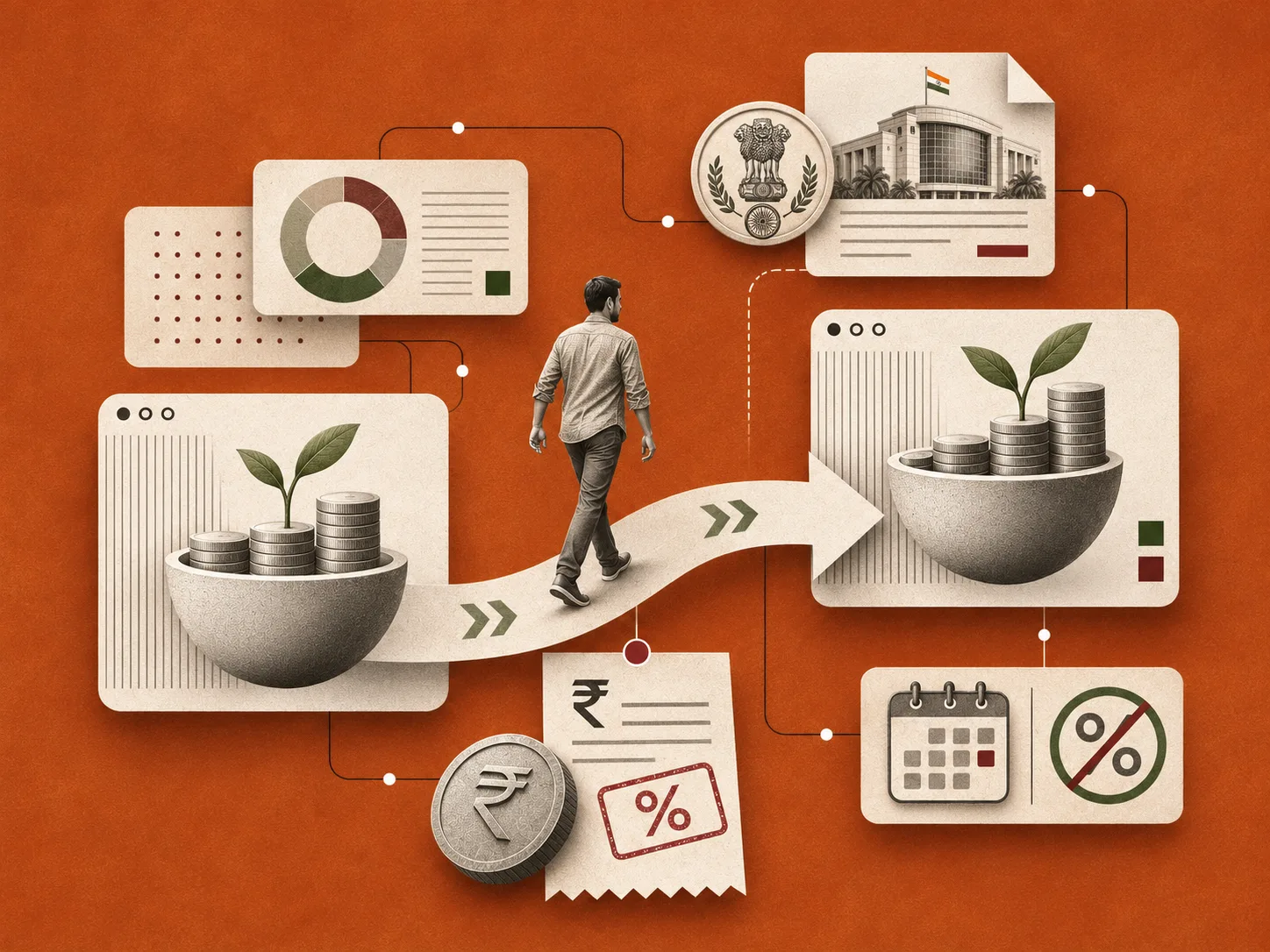
SBI pays 6.75% to a senior citizen on a one-year deposit, and 6.25% to everyone else. Interest is taxed as income, at the slab rate.
Illustration. A senior citizen in the 30% slab, paying 4% cess on top:
| Step | Rate |
|---|---|
| SBI one-year deposit, senior citizen | 6.75% |
| Tax at 30% plus 4% cess (31.2% of the interest) | -2.11% |
| What is kept after tax | 4.64% |
| Retail inflation, September 2026 | 5.54% |
| Gap | -0.90 percentage points |
The rupees come back. On these numbers, they buy a little less than when they went in.
A senior whose income is high enough to pay surcharge keeps less, and the gap widens. Someone in a lower slab keeps more. The table is one case, not a rule.
Most deposits were locked in lower
A rate on today's receipt says little about the money already in the bank.
In March 2026, 61.8% of term deposits paid under 7%. A year earlier, 27.3% did.
RBI raised the repo rate in October 2026. Deposit rates do not move with it on the same day, and an FD already booked keeps its rate until it matures. Compound looked at the October change in RBI raised the repo rate to 5.50%.
The bank also takes its tax first. Banks deduct tax at source on interest above ₹1 lakh a year for senior citizens, and above ₹50,000 for others.
What the bank promises, in writing
The safety has a limit, and it is printed too.
DICGC, RBI's deposit insurance arm, covers ₹5 lakh per depositor per bank. The limit has been ₹5 lakh since 4 February 2020.
Illustration. A father with ₹20 lakh in one bank has ₹5 lakh of it insured. The other ₹15 lakh rests on the bank itself.
By RBI's count, 97.4% of accounts are fully covered. By value, 39.7% of deposits are. So most accounts hold less than ₹5 lakh, while most of the money sits above that limit.
Where his children save
His children keep their savings on a phone.
- Investors under 30 made up 37.7% of NSE's investors in August 2026, up from 23.5% in March 2020.
- The median new investor on the NSE this year is 27.
- In September 2026, 63 lakh new SIPs were registered, and ₹32,490 crore went in through SIPs that month.
Compound looked at that monthly flow in ₹32,490 crore a month in SIPs. For a larger deposit, see What a ₹1 crore FD earns an HNI after tax and inflation.
Two ways to count the same rupee
Both generations want the same thing from their savings. They measure it differently.
The father counts the rupees that come back. His children count what those rupees buy.
The film ends with two questions to ask at home. Where are the savings kept? And what did they earn after tax and prices?
We post the charts behind these pieces on X (@revaprivate) and LinkedIn, and every new piece on our WhatsApp channel. Follow along to get them first.
Questions
- How much of India's bank deposits belong to senior citizens?
- 20.0% in March 2026, by RBI's data on bank deposits. One rupee in every five.
- What does a senior citizen earn on an SBI FD after tax?
- SBI pays 6.75% to seniors on a one-year deposit. In the 30% slab with 4% cess, about 4.64% is kept after tax. Retail inflation was 5.54% in September 2026.
- How much of an FD is covered by deposit insurance?
- DICGC covers ₹5 lakh per depositor per bank. By RBI's count, that fully covers 97.4% of accounts but 39.7% of deposits by value.
- When is TDS deducted on FD interest?
- When interest from a bank crosses ₹1 lakh in a year for a senior citizen, or ₹50,000 for others, under section 393(1) of the Income-tax Act, 2025.
- Do FD rates go up when RBI raises the repo rate?
- Not automatically. Banks set their own deposit rates, and an FD already booked keeps its rate until it matures. In March 2026, 61.8% of term deposits paid under 7%.
Sources
- RBI, BSR-2 on deposits with scheduled commercial banks, March 2026 (29 May 2026)
- RBI Bulletin, Table 52(a), household financial savings 2025-26, preliminary (25 Sep 2026)
- RBI Handbook of Statistics on Indian Economy, Table 71, deposit insurance coverage (31 Mar 2026)
- RBI, deposit insurance cover raised to ₹5 lakh (4 Feb 2020)
- RBI, Monetary Policy Statement (7 Oct 2026)
- SBI, retail domestic term deposit rates below ₹3 crore, effective 15 Dec 2025 (checked 4 Nov 2026)
- MoSPI, Consumer Price Index, September 2026 (12 Oct 2026)
- Income-tax Act, 2025, section 393, tax deducted at source
- NSE, Market Pulse, September 2026
- AMFI, monthly report for September 2026
- Reva Originals, The FD (3 Nov 2026)
Compound is analysis, not investment advice. Reva Money is not a SEBI-registered investment adviser.