A ₹10,000 SIP from 2016 is worth ₹20.37 lakh. In March 2020 it was down 25%
Ten crore SIP accounts paid in this September. The SIP follows one illustrative ₹10,000 a month through ten years of the Nifty, and a twin that paused when the market fell.
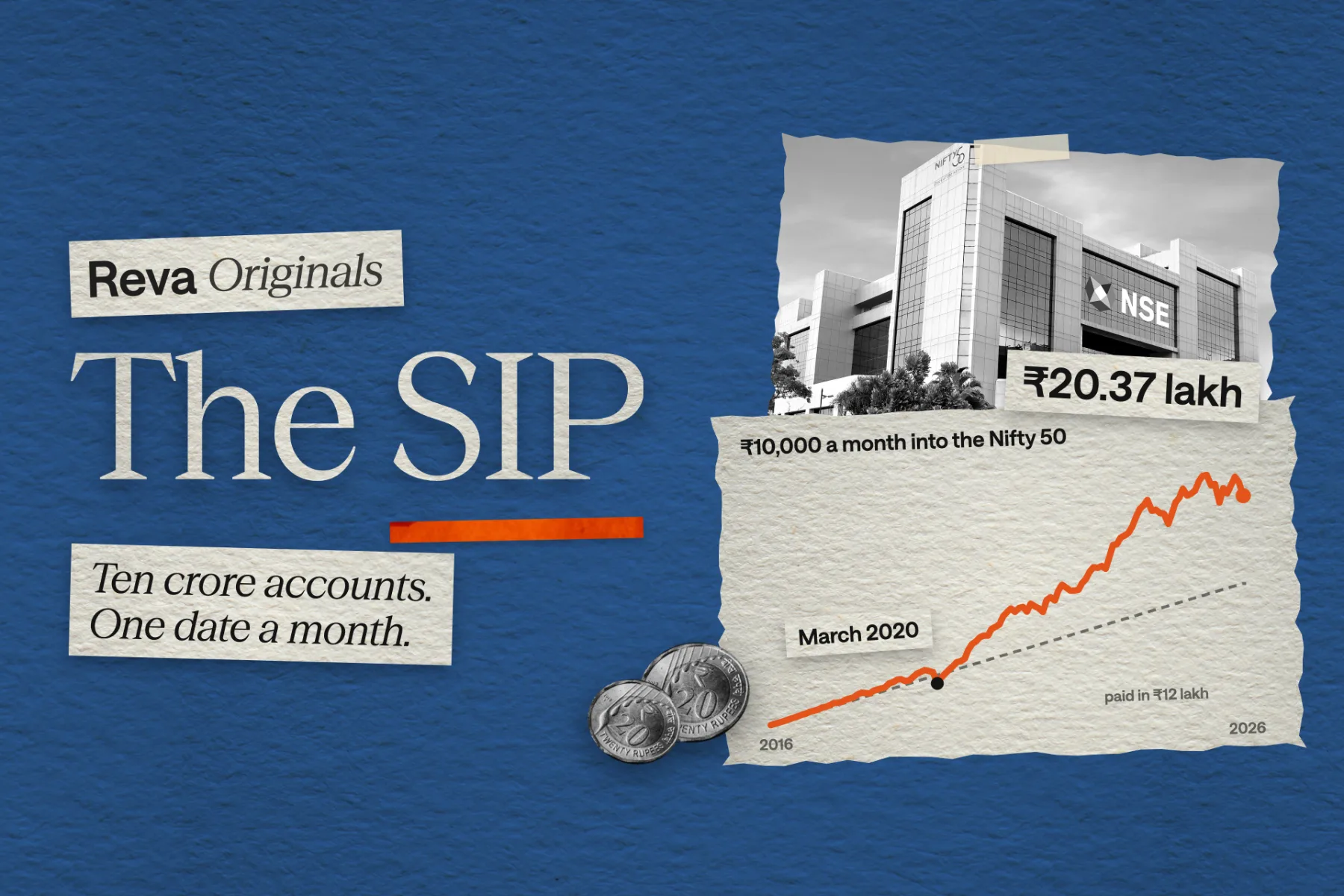
In September 2026, 10.06 crore SIP accounts brought in ₹32,490 crore, the most in any month in AMFI's figures. In Reva's illustration, ₹10,000 on the first trading day of each month from October 2016 into the Nifty 50 Total Returns Index was worth about ₹20.37 lakh on 30 September 2026, on ₹12 lakh paid in. A twin that skipped April to December 2020 was worth ₹18.29 lakh, on ₹11.1 lakh.
Was this forwarded to you? Sign up to get Compound in your inbox.
Every month, on a date picked once, money leaves ten crore bank accounts and goes into mutual funds.
In September 2026, 10.06 crore SIP accounts paid an instalment, by AMFI's data. Together they brought in ₹32,490 crore, the most in any month so far. In April 2016, the first month in AMFI's series, the figure was ₹3,122 crore.
This is the companion piece to The SIP, the fourth film in Reva Originals.
 Play video
One SIP, followed for ten years
The film follows one SIP. It is Reva's illustration, worked out from NSE's published index values:
- ₹10,000 on the first trading day of each month, from 3 October 2016
- invested in the Nifty 50 Total Returns Index, which adds dividends back in
- no fund costs, no tax, no exit load
By 30 September 2026 it had made 120 instalments, ₹12 lakh in all. They were worth ₹20,37,368. That is an XIRR of about 10.2% a year.
| Date | Paid in | Worth | XIRR |
|---|---|---|---|
| 31 Dec 2019 | ₹3,90,000 | ₹4,71,449 | 11.7% |
| 23 Mar 2020 | ₹4,20,000 | ₹3,15,343 | -15.7% |
| 31 Dec 2021 | ₹6,30,000 | ₹10,17,833 | 18.3% |
| 26 Sep 2024 | ₹9,60,000 | ₹20,51,483 | 18.5% |
| 30 Sep 2026 | ₹12,00,000 | ₹20,37,368 | 10.2% |
XIRR is the yearly return that accounts for each instalment's own date. Compound explained it in TWRR or XIRR.
March 2020
The Nifty 50 Total Returns Index fell 23.0% in March 2020. From its January high to its low on 23 March, it fell 38.3%.
On that day the illustrative SIP had ₹4.2 lakh in it, worth ₹3.15 lakh. It was the lowest point of the ten years.
SIP money kept arriving that month. Investors put in ₹8,641 crore, more than in any other month of 2019-20.
The same ₹10,000 bought more units when prices were low. The instalment on 1 April 2020 bought 1.47 times as many units as the one on 1 January 2020.
The four instalments from March to June 2020 were ₹40,000, or 3.3% of everything paid in. By September 2026 they made up 5.0% of the SIP's value.
The twin that paused
The film also follows a twin. It is the same SIP, except it stopped after March 2020 and started again in January 2021.
It skipped nine instalments and paid in ₹11.1 lakh. On 30 September 2026 it was worth ₹18,29,283, an XIRR of about 9.8%.
The gap is ₹2.08 lakh. ₹90,000 of that is money the twin never put in. In the unbroken SIP, those nine instalments grew to ₹2.08 lakh.
Against putting it all in at once
₹12 lakh put into the same index on 3 October 2016, in one go, would have grown about 2.92 times by 30 September 2026. That is about 11.3% a year.
The two aren't a like-for-like contest. A lump sum needs the whole amount on day one. An SIP spreads it across ten years of salary.
The ones who stopped
AMFI marks an SIP as stopped after three missed instalments in a row. Its count of SIPs ending also includes those that ran their full term.
In March 2025, 128 SIPs ended for every 100 that started. That was the third month in a row above 100, after the Nifty 50's peak of September 2024.
In September 2026, 63.26 lakh SIPs were registered and 49.68 lakh ended.
Who stays
More SIP money now stays put. In March 2026, 31% of SIP assets had been invested for more than five years, against 12.3% in March 2021, by the AMFI Crisil Factbook.
The crowd is also younger and larger:
- Mutual fund investors rose from 2.3 crore in March 2021 to 6.1 crore in March 2026.
- Of new investors on the NSE from April to August 2026, 59% were under 30.
- Their median age was 27.
Compound looked at the September flows in ₹32,490 crore a month in SIPs.
What the illustration leaves out
- Costs and tax. An index fund charges an expense ratio, and gains are taxed when units are sold. The illustration has neither.
- A real fund. A fund doesn't match its index exactly.
- The end date. 30 September 2026 came after a 6.0% fall that month, 13% below the index's January high. Valued on 2 January 2026, the same SIP showed an XIRR of 14.7%.
To work out a monthly amount for your own goal, Reva Learn has a three-minute lesson, How much to invest for a goal.
We post the charts behind these pieces on X (@revaprivate) and LinkedIn, and every new piece on our WhatsApp channel. Follow along to get them first.
Questions
- How much money goes into SIPs in India each month?
- ₹32,490 crore in September 2026, from 10.06 crore SIP accounts, the most in any month in AMFI's figures. In April 2016, the first month in AMFI's series, it was ₹3,122 crore.
- What would ₹10,000 a month in the Nifty 50 since 2016 be worth?
- In Reva's illustration, ₹10,000 on the first trading day of each month from 3 October 2016 into the Nifty 50 Total Returns Index, with no costs or tax, was worth about ₹20.37 lakh on 30 September 2026 on ₹12 lakh paid in, an XIRR of about 10.2%.
- What happened to SIPs that paused in 2020?
- In the same illustration, a SIP that skipped April to December 2020 paid in ₹11.1 lakh and was worth ₹18.29 lakh on 30 September 2026, ₹2.08 lakh less than the unbroken SIP. ₹90,000 of that gap is money it never put in.
- When does AMFI count a SIP as stopped?
- After three missed instalments in a row for monthly SIPs. AMFI's count of SIPs ending also includes SIPs that completed their term.
- How long do investors keep their SIP money?
- In March 2026, 31% of SIP assets had been invested for more than five years, against 12.3% in March 2021, by the AMFI Crisil Factbook 2026.
Sources
- AMFI, SIP contributions and accounts, data to September 2026
- AMFI Monthly Note, September 2026
- AMFI, monthly report for April 2016
- AMFI Crisil Factbook 2026 (pp. 12, 31)
- NSE Indices, Nifty 50 Total Returns Index historical values (read 22 Oct 2026)
- NSE Market Pulse, September 2026, Tables 74-75
- Reva Originals, The SIP (10 Nov 2026)
Compound is analysis, not investment advice. Reva Money is not a SEBI-registered investment adviser.