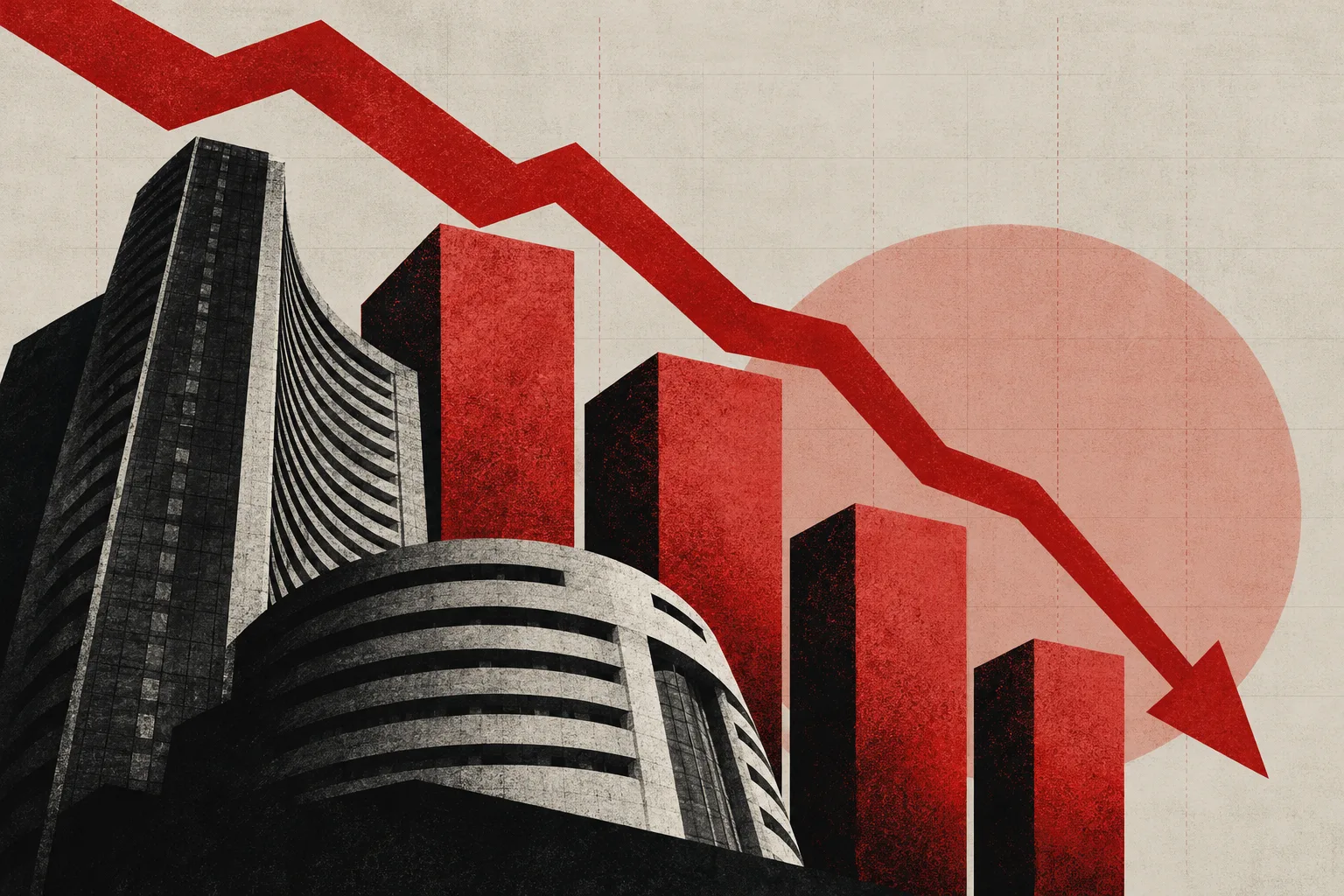
The Flat: how much of an Indian family's wealth sits in bricks
RBI's last full count put 77% of the average household's assets in real estate. New savings still go to bricks first. The numbers behind our second film, The Flat.
The average Indian household held 77% of its assets in real estate, by RBI's Household Finance Committee, the latest official split. In 2024-25 households put 13.6% of national disposable income into physical assets such as homes, against 7.0% into net financial savings. RBI's house price index rose 3.6% in the year to June 2026.

Was this forwarded to you? Sign up to get Compound in your inbox.
The Flat, the second Reva Original, premiered on 27 October. It asks why India keeps its wealth in bricks.
This piece sets out the figures behind the film, each with its source.
 Play video
1. Most of what a family owns is property
The latest official split of household wealth is from 2017. RBI's Household Finance Committee found the average household held 77% of its assets in real estate. Gold was 11% and financial assets 5%.
The government's All India Debt and Investment Survey gives the same picture for cities. In its 2019 round, land was 49% of urban household assets and buildings 38%. Deposits were 9%.
No official count since then splits household wealth by asset.
2. New savings still go to bricks first
RBI's Annual Report 2025-26 shows where a year's savings went. Households saved 21.3% of national disposable income in 2024-25:
- 13.6% in physical assets, mostly homes and buildings
- 7.0% in net financial savings
- 0.7% in valuables such as gold
Net financial savings are what households added to deposits, funds and shares, minus what they borrowed.
Physical savings were about 1.9 times financial savings in 2024-25. In 2022-23 they were 2.7 times.
3. Prices rose slowly on average, faster at the top
RBI's house price index is built from registration records in 18 cities. It rose 3.6% in the year to April–June 2026. Chandigarh, Jaipur, Kanpur, Lucknow and Thiruvananthapuram led the rise.
RBI projects consumer inflation of 5.2% for 2026-27, above that 3.6%.
Knight Frank India, a property consultancy, counts new-home sales in eight big cities. Its H1 2026 report shows the expensive end moving faster:
- 54% of homes sold in January–June 2026 cost ₹1 crore or more, up from 49% a year earlier
- Delhi prices rose 18% in a year, to ₹26,027 a sq ft
- Mumbai averaged ₹36,881 a sq ft, up 5%
- Hyderabad averaged ₹8,258 a sq ft, up 7%
A Knight Frank and CII study found prices in 11 smaller cities rose 63% from 2021 to 2026. The eight biggest rose 42%.
The two sources measure different things. RBI's index covers registered sales in 18 cities. Knight Frank covers new homes in eight.
4. The loan
The average new home loan was ₹34.2 lakh in January–March 2026, by credit bureau CRIF High Mark. That was 10.6% more than a year earlier.
Take a ₹2 crore flat bought with an 80% loan of ₹1.6 crore, over 20 years at 8.5%:
| Amount | |
|---|---|
| Monthly EMI | ₹1,38,852 |
| EMIs paid in year one | ₹16.7 lakh |
| Interest in year one | ₹13.5 lakh |
| Principal repaid in year one | ₹3.2 lakh |
| Total interest over 20 years | ₹1.73 crore |
The ₹40 lakh down payment, stamp duty and registration come on top. Stamp duty differs by state.
RBI raised the repo rate by 25 basis points to 5.50% on 7 October 2026. Floating home loans linked to the repo rate move with it. On this loan, a rise of 0.25 points adds about ₹2,540 a month.
The 8.5% rate is an illustration, not any lender's offer. The figures are Reva's arithmetic.
5. Renting the same flat
India has no official series for rent as a share of price. So here is the arithmetic for a range.
Gross yield is a year's rent divided by the price, before maintenance, tax and empty months. On the same ₹2 crore flat:
- at a 3% gross yield, rent is ₹50,000 a month
- at a 4% gross yield, rent is about ₹66,700 a month
Both are below the ₹1,38,852 EMI. Part of each EMI repays principal, which stays with the owner. In year one that part is ₹3.2 lakh of the ₹16.7 lakh paid.
6. A slice of a building
Real estate investment trusts, or REITs, own offices and malls and pay out most of their rent. India has six listed REITs with more than 4.8 lakh unitholders, by the Indian REITs Association, an industry body.
7. Tax when a flat is sold
A home held for more than 24 months is a long-term asset. Long-term gains on sales from 23 July 2024 are taxed at 12.5% without indexation, plus surcharge and cess.
Residents and HUFs selling land or a building bought before that date can pay the lower of two figures. One is 12.5% without indexation. The other is 20% with indexation. The rule sits in section 197 of the Income-tax Act, 2025. Work out which applies with your CA.
We post the charts behind these pieces on X (@revaprivate) and LinkedIn, and every new piece on our WhatsApp channel. Follow along to get them first.
Questions
- How much of Indian household wealth is in real estate?
- 77% of the average household's assets, by RBI's Household Finance Committee (2017). Gold was 11% and financial assets 5%. No later official count splits wealth by asset.
- Do Indian households still save more in property than in financial assets?
- Yes. In 2024-25 they put 13.6% of national disposable income into physical assets and 7.0% into net financial savings, by RBI's Annual Report 2025-26.
- How fast are Indian house prices rising?
- RBI's house price index for 18 cities rose 3.6% in the year to April–June 2026. Knight Frank India puts Delhi's rise at 18% and Mumbai's at 5% for new homes over the same period.
- What is the EMI on a ₹1.6 crore home loan?
- About ₹1,38,852 a month over 20 years at an illustrative 8.5%. Year one's EMIs total ₹16.7 lakh, of which ₹13.5 lakh is interest.
- How is the sale of a flat taxed in India?
- After 24 months, long-term gains on sales from 23 July 2024 are taxed at 12.5% without indexation. Residents and HUFs selling property bought before that date can pay the lower of that and 20% with indexation.
Sources
- RBI, Report of the Household Finance Committee (24 Aug 2017)
- NSO, All India Debt and Investment Survey 2019, press note (24 Aug 2021)
- RBI Annual Report 2025-26, appendix table on gross savings (29 May 2026)
- RBI, All-India House Price Index for Q1 2026-27 (24 Aug 2026)
- RBI, Monetary Policy Statement, MPC resolution (7 Oct 2026)
- Knight Frank India, India Real Estate: Office and Residential Market H1 2026 (Jul 2026)
- Knight Frank India and CII, India's Next Real Estate Markets (Sep 2026)
- CRIF High Mark, How India Lends (May 2026)
- Indian REITs Association, home page (read 20 Oct 2026)
- Income-tax Act, 2025, section 197
- Reva Originals, The Flat (27 Oct 2026)
Compound is analysis, not investment advice. Reva Money is not a SEBI-registered investment adviser.