
Bonds get a colour-coded credit meter from 21 Nov 2026. What it measures and what it leaves out
From 21 November 2026, every listed bond, NCD, commercial paper and market-linked debenture must carry SEBI's Credit Risk-o-Meter, a six-colour scale built on the rating, in its offer document, its advertisements and on online bond platforms. The meter uses the lowest rating where agencies differ and flags unsecured bonds in red. It scores credit risk only, so a AAA bond still shows green when its price can fall with interest rates.

Was this forwarded to you? Sign up to get Compound in your inbox.
SEBI issued a circular on 7 October 2026 that adds a colour-coded Credit Risk-o-Meter to debt securities. It comes into force 45 days after issue, which is 21 November 2026.
The circular reaches every route by which a bond gets to an investor: a public issue, a private placement, and the online bond platforms (OBPPs) that SEBI regulates.
Where the meter will appear
The circular covers all listed and proposed-to-be-listed non-convertible securities, commercial paper, securitised debt instruments, security receipts and market-linked debentures, whether sold in a public issue or a private placement. The meter must appear in:
- the offer document and the abridged prospectus
- the private placement memorandum
- every advertisement by the issuer or an online bond platform that mentions the bond's rating
- the bond listing and bond details pages of an online bond platform, above the button to invest
A black-and-white print advertisement must carry a QR code that leads to the meter in colour.
The six levels
SEBI maps the rating scale onto six levels. The colour names and codes come from Annexure A of the circular.
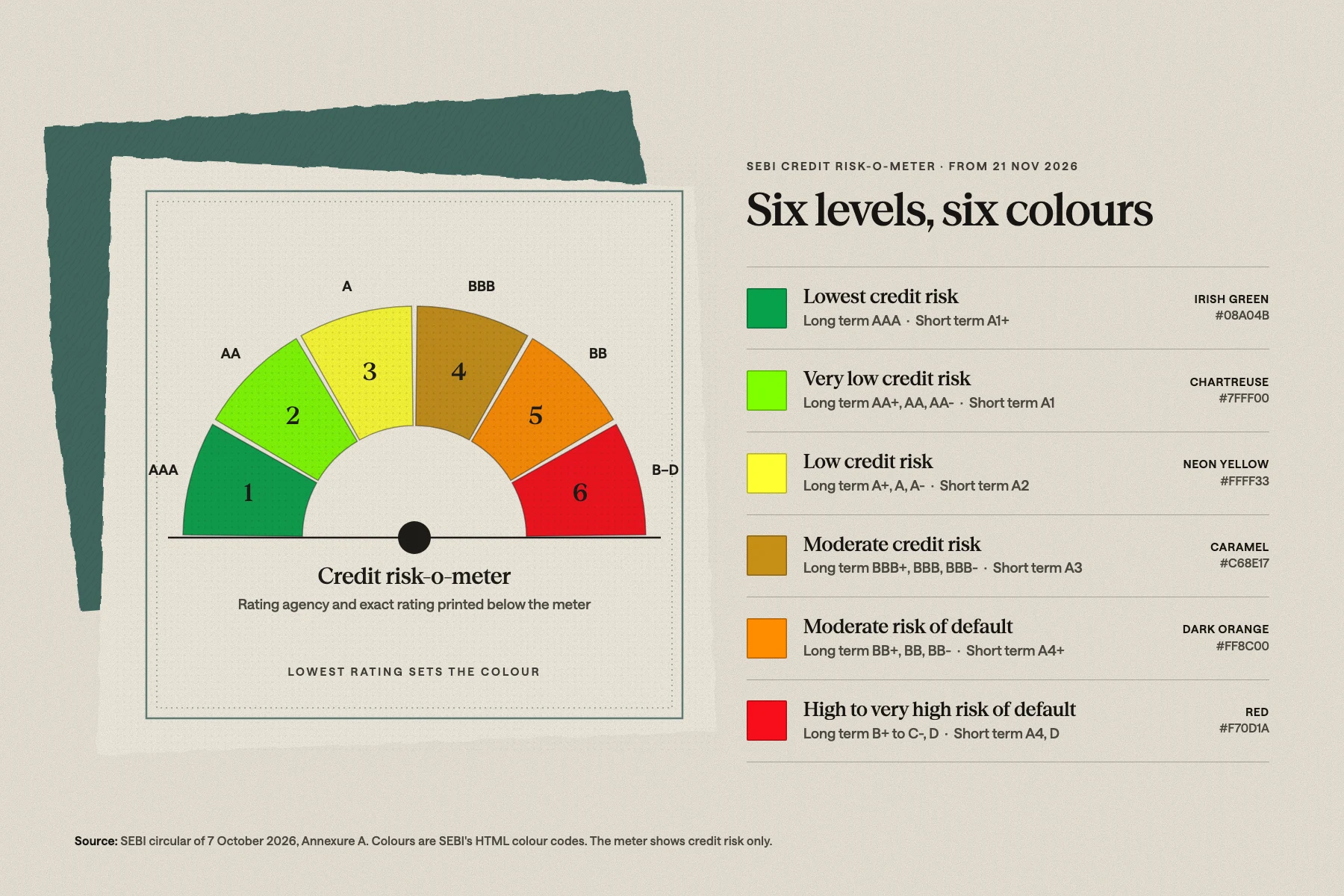
| Level | Long-term rating | Short-term rating | Colour |
|---|---|---|---|
| Lowest credit risk | AAA | A1+ | Irish Green |
| Very low credit risk | AA+, AA, AA- | A1 | Chartreuse |
| Low credit risk | A+, A, A- | A2 | Neon Yellow |
| Moderate credit risk | BBB+, BBB, BBB- | A3 | Caramel |
| Moderate risk of default | BB+, BB, BB- | A4+ | Dark Orange |
| High to very high risk of default | B+ down to D | A4, D | Red |
The four middle bands each hold three rating notches. An AA+ bond and an AA- bond show the same colour, and so do A+ and A-. The text under the meter still has to give the exact rating and the name of the rating agency, so the notch is on the page; the colour does not show it.
Three rules in the fine print
The lowest rating sets the colour. When two agencies rate the same bond differently, the meter must show the lower one. A bond rated AA by one agency and A+ by another shows Neon Yellow. Issuers may list all the ratings beside the meter.
Unsecured bonds are marked in red text. Below the meter, the word "unsecured" must appear in bold red. For unsecured perpetual bonds such as AT1 bonds, the issuer must add a warning that the meter does not reflect their structural risks and that these bonds "may carry the risk of total loss of invested capital".
Rating changes reach the platform within a day. An online bond platform must update the meter within 24 hours of NSDL or CDSL recording a rating change, through an automated system, with no manual overrides and an audit trail of every change. If an agency says the issuer is not cooperating, the meter must point to that status.
What the meter does not measure
SEBI requires this disclaimer under the meter: "The Credit risk-o-meter is based on evaluation of the credit risk of the issuer and does not constitute investment advice or a recommendation to invest. Investments in debt securities are also subject to market and liquidity risks."
Mutual fund investors have seen a similar dial since 1 January 2021, built on different inputs. SEBI's October 2020 circular scores a debt fund on three things: credit rating, interest rate risk measured by Macaulay duration, and liquidity, which depends on whether a holding is listed and how it is structured. The bond meter takes only the first of the three. Two bonds that both show Irish Green can differ a great deal in how far their price moves with interest rates and in how easily they can be sold before maturity.
An illustration with hypothetical figures: ₹1 crore in a AAA bond with a modified duration of 7 years falls by about 7% in price, or about ₹7 lakh, if market yields rise by 1 percentage point. The meter stays green throughout, because the issuer's ability to pay has not changed. Held to maturity, the bond still pays its coupons and principal as scheduled; sold before maturity, it sells at the lower price.
A rating is also an agency's view at a point in time. The meter moves when the rating moves, so it shows a downgrade on the platform within 24 hours of the depository record, after the agency has acted.
What changes for a bond buyer
From 21 November 2026, the colour for a bond's lowest rating, the word "unsecured" in red where it applies, and the AT1 warning have to sit next to the invest button on a bond platform and in every advertisement that quotes the rating. The same meter goes into the offer document or placement memorandum of each new issue.
The circular is a disclosure rule. It amends SEBI's master circular on non-convertible securities and leaves the rating process and every other provision of that master circular unchanged.
Questions
- When does SEBI's Credit Risk-o-Meter for bonds start?
- The circular is dated 7 October 2026 and comes into force 45 days after issue, which is 21 November 2026.
- Which debt securities need the Credit Risk-o-Meter?
- All listed and proposed-to-be-listed non-convertible securities, commercial paper, securitised debt instruments, security receipts and market-linked debentures, by public issue or private placement.
- Which rating does the meter use if two agencies disagree?
- The lowest one. Issuers and platforms may show the other ratings beside the meter.
- What colour is an AA-rated bond on the Credit Risk-o-Meter?
- Chartreuse, the "Very low credit risk" level, which covers AA+, AA and AA-, and A1 for short-term paper.
- Does a green meter mean a bond's price cannot fall?
- No. The meter measures credit risk only, and SEBI's disclaimer says debt securities also carry market and liquidity risks. A bond's price still moves with interest rates.
- How quickly do online bond platforms update the meter after a downgrade?
- Within 24 hours of NSDL or CDSL recording the rating change, through an automated system with no manual overrides.
Sources
- SEBI, Introduction of Credit Risk-o-Meter as an additional disclosure mechanism for debt securities (7 Oct 2026)
- SEBI, Circular text and Annexure A, PDF (7 Oct 2026)
- SEBI, Product labeling in mutual fund schemes: Risk-o-meter (5 Oct 2020)
Compound is analysis, not investment advice. Reva Money is not a SEBI-registered investment adviser.