
JPMorgan has shut outside AI agents out of its accounts. In India, the question is who carries the loss
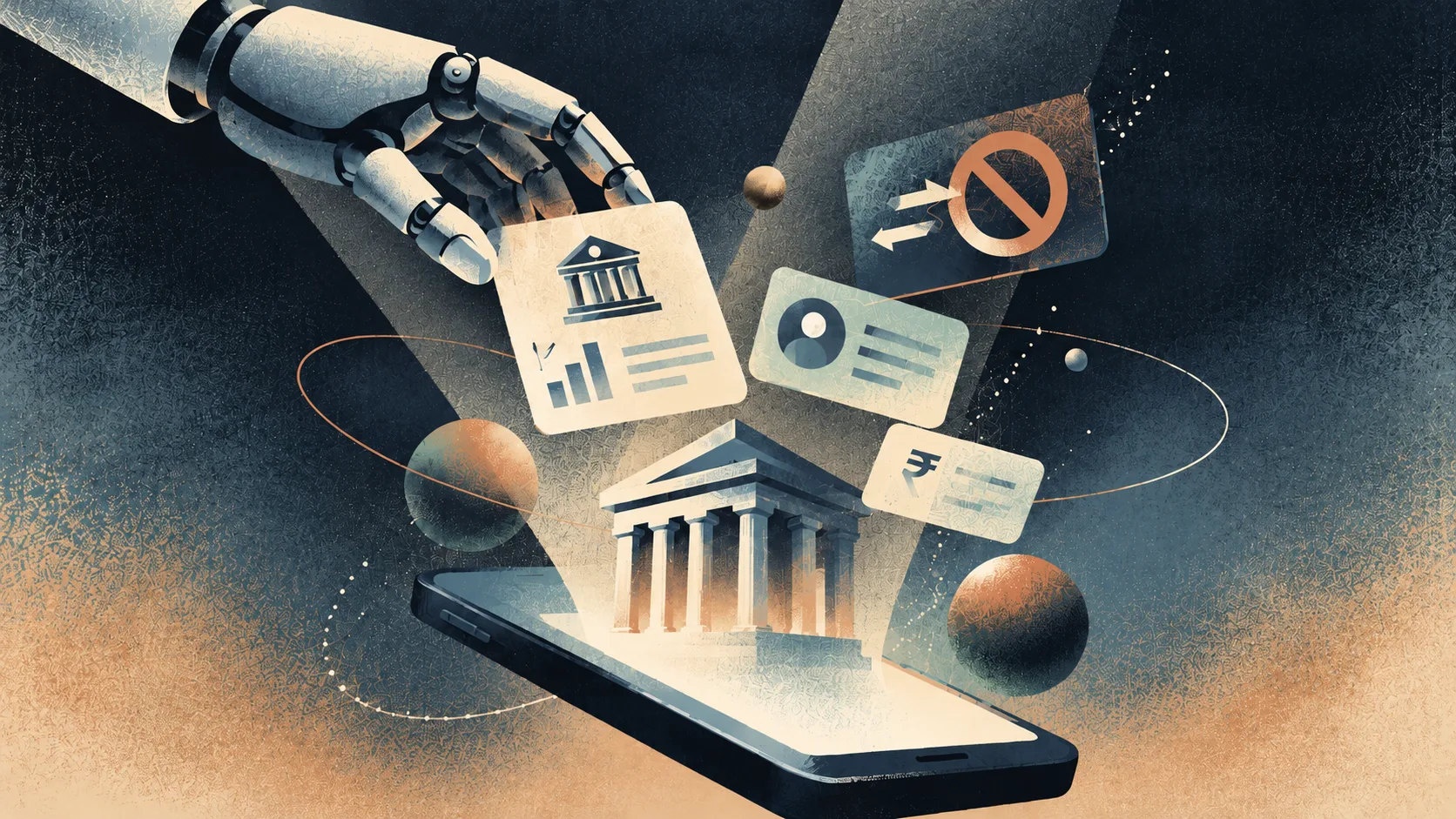
On 13 October Jamie Dimon said JPMorgan will not let outside AI agents log in to customer accounts or move money, though they can still read balances through approved connectors. Morgan Stanley went the other way in June and opened its stock-plan platforms to clients' agents, for reading data. Both banks drew the same line between reading and acting. India drew that line years ago, in an RBI rule on shared passwords and in the Account Aggregator framework. That matters more now that people are building their own money apps with AI.
Was this forwarded to you? Sign up to get Compound in your inbox.
On 13 October, on JPMorgan Chase's third-quarter earnings call, Jamie Dimon said the bank would not let outside AI agents operate customer accounts. "You don't want rogue agents, and there could be thousands of them," he said, according to PYMNTS. He added that customers who use outside agents should understand "the liability transfer".
The block is narrower than the headlines. A JPMorgan spokesperson told Fortune that the bank supports "secure, customer-authorized data sharing through open banking providers" and does not allow agents that get into accounts by obtaining a customer's banking credentials. Agents can still see balances, read-only, through a connector such as Plaid that the customer has approved. They cannot sign in with your password, send money or pay bills. The agent most in the news, Meta's Muse, launched in September and reads financial accounts through a Plaid integration.
Morgan Stanley moved in the other direction four months earlier. On 4 June it opened ShareWorks and Equity Edge, its platforms for employee stock plans, to clients' AI agents through the Model Context Protocol, starting with a small group of clients and planning to reach all 3,400 administration clients by next year. "In the future state, our corporate clients will not be logging into ShareWorks or Equity Edge," said Mark Mitchell, chief product officer of Morgan Stanley at Work. What the agents get is data.
Read together, the two decisions agree. Both banks let a customer's agent read. Neither lets an outside agent act on an account with the customer's own login.
The Indian version of "liability transfer"
India has a written rule on who pays when someone else uses your banking credentials. RBI's circular of 6 July 2017 on unauthorised electronic banking transactions sets out three cases.
| Case | Who bears the loss |
|---|---|
| The bank is at fault | The bank. The customer's liability is zero |
| A third party breached the system, and the customer tells the bank within 3 working days of being informed | The bank. The customer's liability is zero |
| Same, reported within 4 to 7 working days | The customer, up to the transaction value or a cap, whichever is lower. The cap is ₹10,000 on most savings accounts and on individual current accounts up to ₹25 lakh, and ₹25,000 on other current accounts and on credit cards with limits above ₹5 lakh |
| The loss is due to the customer's negligence, "such as where he has shared the payment credentials" | The customer bears the entire loss until the transaction is reported to the bank |
The last row is the one that applies to AI agents. Suppose you give an agent your net banking login for a savings account holding ₹40 lakh, and the agent's provider is breached or the agent is tricked into a transfer. On the circular's wording, sharing the login puts the loss on you until you report it, which is the same "liability transfer" Dimon described. We found no RBI guidance or Banking Ombudsman decision that deals with AI agents specifically, so how a bank or the Ombudsman would treat a particular case is untested. The wording of the 2017 rule is plain enough to take seriously.
India already has a read-only route
The route JPMorgan allows, customer-approved sharing that gives read access, has existed in India since RBI's Account Aggregator Directions of 2016. Three clauses do most of the work. Under paragraph 6.1, no financial information is retrieved, shared or transferred "without the explicit consent of the customer". Paragraph 5(7) says information the aggregator fetches from banks and other providers shall not "reside with the Account Aggregator", so the aggregator passes data through and cannot keep it. And under paragraph 5(6) an aggregator can do no other business. The framework moves information only and has no way to move money.
The network is large. Sahamati's July 2026 newsletter lists 17 operational aggregators, 176 banks and other information providers live, and 1,076 lenders, brokers and other users live. Coverage is uneven at the edges. A family whose money sits across a private bank, two brokers, a PMS and an AIF will usually find some of those accounts reachable through the network and some only through statements.
Regulated firms that use AI carry their own duty. Since February 2025, SEBI's Intermediaries Regulations have included a chapter on the use of AI that makes a registered intermediary solely responsible for the data privacy and security of what its AI tools handle, for the tools' outputs, and for compliance with the law, whether it built the tool or bought it. RBI's FREE-AI committee reported in August 2025 with 26 recommendations for lenders' use of AI. It is a committee report, and its recommendations are not yet rules.
"Everyone will build their own"
Software stocks fell hard from early February 2026 on the worry that AI agents would replace software sold by the seat, a sell-off the market nicknamed the "SaaSpocalypse". Estimates of the value lost vary by source and by period. By 30 June Forbes was reporting a 13% rebound in software stocks, and on 9 October Yahoo Finance argued the term should be retired. We have seen no market data that shows a second sell-off this month.
The part of the argument that applies to your own money is simpler. With an AI coding tool, a motivated person can build a personal net worth tracker in a weekend. Founders have documented replacing paid tools this way, Pieter Levels among them. A home-built tracker has real advantages. You decide where the data lives, nobody else sees it, and it costs nothing a month.
At ₹1 crore and above, three things decide whether a tracker you build, or any app you use, is safe and right.
It never holds a password. A tracker that reads statement PDFs you download, or data you approve through an aggregator, holds no login. A tracker or agent that signs in to net banking or a broker with your password is in the negligence row of the RBI table above.
It cannot move money. Reading a balance and paying a bill are different permissions. An agent that can only read can show you a wrong number, which is bad. An agent that can act can lose money, and in India the loss can stay with you.
It keeps up with the rules. Long-term capital gains tax on equity funds went from 10% to 12.5% for sales on or after 23 July 2024, and the yearly exemption went from ₹1 lakh to ₹1.25 lakh. Most debt funds bought on or after 1 April 2023 are taxed at your slab rate however long you hold them. A tracker written before July 2024 and never updated reports the wrong tax for every year since.
The cost of a mistake grows with the portfolio. Take ₹10 lakh of long-term gain on an equity fund.
| Read as | Tax worked out | Tax |
|---|---|---|
| Equity fund, long term | (₹10 lakh − ₹1.25 lakh) × 12.5% × 1.04 cess | ₹1,13,750 |
| Debt fund bought after 1 April 2023, at a 30% slab | ₹10 lakh × 30% × 1.04 cess | ₹3,12,000 |
That is a ₹1,98,250 difference before surcharge from one wrong label. A model asked to "read my CAS" can produce that label, or skip a fund that was fully sold during the year, and nothing on the screen looks wrong. Checking the arithmetic catches it. On a CAMS + KFintech statement, units × NAV should equal each fund's printed value, the funds should add up to the printed total, and opening units plus purchases minus sales should equal closing units.
There is a privacy cost too. If your home-built app sends the statement to a hosted AI model to read it, your folio data has left your machine, under that provider's terms.
Where Reva stands
Reva reads. It never asks for bank or broker passwords and cannot move money or place trades. Your statement is unlocked and read in your browser, and the PDF and its password never reach us. Reva saves the figures, and only after every check on the statement passes. Reva's agents and Hey Reva can read the data you allow and nothing else. When they write a reply, the figures they read go to an AI model provider outside India, which our privacy notice names. Account Aggregator linking is not live in Reva yet, so today data comes from statements you add and assets you enter.
If you would rather build your own tracker, the three tests above apply to it as much as to us. Ask the same questions of any money app or agent before you connect it. Does it hold my password? Can it move money? Where do my data and the model run? Who pays if it gets a number wrong? Can I delete everything?
This piece describes bank policies, regulations and how Reva works. It is not a recommendation to use or avoid any product or service.
Questions
- What did JPMorgan announce about AI agents?
- On its 13 October 2026 earnings call, JPMorgan said it will not let outside AI agents sign in to customer accounts with the customer's credentials or act on them, for example by sending money or paying bills. It still allows read-only data sharing that the customer authorises through open-banking providers such as Plaid.
- Can I give an AI agent my net banking password in India?
- RBI's 6 July 2017 circular says that where a loss is due to the customer's negligence, such as sharing payment credentials, the customer bears the entire loss until they report the transaction to the bank. We found no RBI guidance specific to AI agents, but the rule covers shared credentials generally.
- How is Account Aggregator different from giving an app my login?
- An Account Aggregator shares financial information only with your explicit consent, cannot keep the data it passes on, and cannot move money. An app that holds your login can do whatever your login allows.
- Is a home-built portfolio tracker safe?
- It can be, if it never holds a password, cannot move money, and is updated when tax rules change. At larger portfolios, one misread fund type can change the tax on a ₹10 lakh gain by about ₹2 lakh.
- Does Reva use AI on my data?
- Reva reads statements in your browser and stores figures only after the checks pass. When you ask Hey Reva or run an agent, the figures it is allowed to read go to an AI model provider outside India to write the reply. Reva cannot move money or place trades.
Sources
- PYMNTS: Jamie Dimon Slams the Door on Rogue AI Agents (13 Oct 2026 call)
- Fortune: Jamie Dimon bars outside AI agents like Meta's Muse from JPMorgan accounts
- CNBC: JPMorgan Chase blocks outside AI agents from directly accessing accounts
- Yahoo Finance: Morgan Stanley to plug stock-plan platforms with external AI agents (4 Jun 2026)
- RBI circular RBI/2017-18/15: Limiting Liability of Customers in Unauthorised Electronic Banking Transactions (6 Jul 2017)
- RBI Master Direction: NBFC Account Aggregator (Reserve Bank) Directions, 2016
- Sahamati Varta newsletter (published July 2026): ecosystem figures
- SCC Online: SEBI Intermediaries (Amendment) Regulations 2025, chapter on use of AI
- RBI press release: FREE-AI committee report (13 Aug 2025)
- Forbes: The SaaSpocalypse May Be Ending (30 Jun 2026)
- Yahoo Finance: The AI SaaSpocalypse was supposed to crush software stocks (9 Oct 2026)
- Pieter Levels: I replaced all these SaaS with my own vibe coded services
- Income Tax Department: Finance Acts, incl. Finance (No. 2) Act 2024 on capital gains rates
Compound is analysis, not investment advice. Reva Money is not a SEBI-registered investment adviser.